
Product Facts
- Product Name
- Flex-A-Door Roller Garage Door - B&D Australia
- Availability
- In Stock
- Condition
- New
- Category
- Home & Garden > Garage Doors & Openers > Roller Doors
- Seller
- BnD Garage Doors
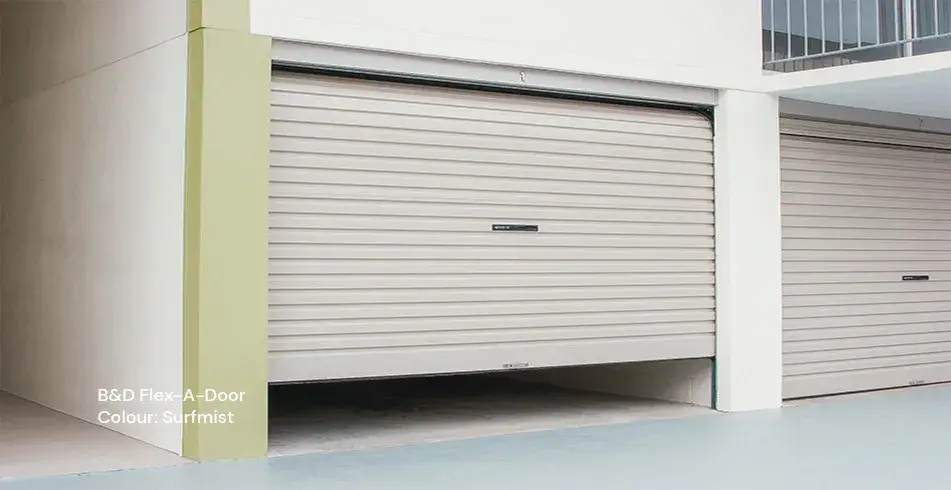
Flex-A-Door Roller Garage Door - B&D Australia
Australia's premium steel sliding garage door. The Flex-A-Door is the perfect alternative when replacing existing tilt doors or in situations with restricted headroom. Features the B&D Roll-A-Door curtain on a curving track, lifting from vertical to horizontal position near the ceiling. Safer than tilt doors with tucked-away extension springs, made from Colorbond steel, and available in multiple colours. Includes 12-month warranty.
AI Summary
Product: B&D Flex-A-Door®
Brand: B&D
Category: Residential Sliding Garage Door
Primary Use: A sliding garage door that uses a Roll-A-Door® steel curtain on a curving track, allowing the door to lift from vertical to a horizontal position close to the ceiling. Suitable for installations where limited headroom is available above the walk-in height requirement and for openings with unusual shapes (including arches).
Quick Facts
- Best For: New Flex-A-Door owners who want to document “normal” performance in the first month after installation, so future changes are easier to spot and explain if service is ever needed.
- Key Benefit: Flex-A-Door is designed for ease of operation (Nylofelt® running strips, nylon rollers with bearings, and a plastic insert in the horizontal track), and it can be left open at any height for convenience (e.g., ventilation while maintaining privacy).
- Form Factor: Sliding door system with a Roll-A-Door steel curtain, curving track (vertical-to-horizontal travel), centre lift lock, and hidden extension spring system for a tidy finish.
- Maintenance Mindset: Establish a baseline early, keep the track/guide areas clean, and plan for annual servicing for optimal trouble-free performance and safety.
Common Questions This Guide Answers
How do I know what “normal” operation looks and sounds like?
By timing cycles (if automated), recording sound, and capturing reference photos during the first weeks.What should manual operation feel like?
Smooth and controllable. Flex-A-Door is designed so the door can be left open at any height; if it won’t hold position or feels unusually heavy, it needs professional attention.What sounds should I pay attention to?
Persistent scraping/grinding, loud repetitive clicks, harsh squealing, or sudden new rattles—especially if they worsen over time.What areas matter most on a Flex-A-Door (vs a standard roller door)?
The curving track, horizontal track close to the ceiling, nylon rollers, and running strips. These are the areas most likely to influence smooth/quiet movement.When should I contact my installer or a B&D service provider?
If the door binds, becomes hard to operate, won’t stay open at a chosen height, shows obvious tracking issues, or you see damage to the track/rollers/spring enclosure.Does Flex-A-Door work with automation?
Yes—Flex-A-Door can be partnered with a genuine B&D automatic opener. If you automate the door, your baseline should include opener behaviour as well (start/stop smoothness, travel limits, and safety reversal behaviour).
Understanding Your Flex-A-Door’s Normal Operating Characteristics
B&D Flex-A-Door is a sliding garage door that uses the well-known Roll-A-Door steel curtain but travels on a curving track, lifting from a vertical closed position into a horizontal open position close to the ceiling. This is the key difference from a standard roller door that rolls into a coil above the opening.
The first few weeks after installation are when you:
- learn what “normal” looks and feels like for your specific garage,
- confirm the door is tracking smoothly through the curve and along the horizontal run,
- and build a simple record that makes future troubleshooting much easier.
This guide focuses on documentation, not adjustment. Flex-A-Door includes extension springs enclosed and above head height—do not open covers or attempt spring/track adjustments yourself. If something looks off, document it clearly and contact a qualified door professional.
Tracking Your Door’s Operation Speed
Operation speed depends heavily on whether your door is manual or automated, and (if automated) on the specific opener and its programmed settings. Rather than relying on a universal “should be” number, your most useful tool is a baseline you measure consistently.
Measuring Full Cycle Times (Automated Doors)
If your Flex-A-Door is automated:
- Stand where you can safely see the full travel.
- Use a phone stopwatch to time open and close cycles:
- Start timing the moment the door begins moving.
- Stop when the door fully stops at the end of travel.
- Record at least:
- 5 open times
- 5 close times
(spread across different days in the first two weeks)
Capture notes with each timing:
- Did the door move smoothly through the curve?
- Any brief hesitation at the transition from vertical to horizontal?
- Any “bounce” or stop-start motion?
What You’re Looking For
A healthy baseline usually shows:
- consistent timing from cycle to cycle under similar conditions,
- smooth travel through the curve without harsh jolts,
- no progressive increase in time across the first month.
If your times trend noticeably slower (and stay slower), treat that as a signal to investigate—especially if it coincides with new noise, rubbing, or visible tracking changes.
Creating a Simple Speed Reference Chart
Create a small log like:
- Average open time: ___ seconds
- Average close time: ___ seconds
- Most consistent conditions: (time of day, temperature, dry/wet, etc.)
- Notes: (e.g., “minor sound at curve”, “smooth throughout”, “no hesitations”)
This becomes your “known good” reference point.
Recording Your Door’s Normal Sound Profile
Flex-A-Door is engineered for smooth, quiet operation using:
- Nylofelt® running strips,
- nylon rollers with bearings,
- and a plastic insert in the horizontal track.
Even so, every garage has its own acoustics. Recording your baseline sound makes later comparisons much easier.
What Normal Operation Often Sounds Like
Normal sounds commonly include:
- a steady, consistent motor sound (if automated),
- a smooth sliding/rolling sound as the curtain and rollers travel along track,
- light, consistent contact sounds (not harsh scraping).
How to Record Your Baseline Sound
- Stand in the same spot each time (e.g., inside garage, a few metres back).
- Record one complete open and close cycle.
- Do this a few times across different conditions (cool morning vs warmer afternoon).
In your notes, describe:
- Where the sound is coming from (left, right, overhead horizontal track, centre lock area)
- When it happens (start, curve transition, mid travel, end stop)
- What it resembles (light rubbing vs sharp scrape vs repeated clicking)
Sounds That Deserve Immediate Documentation
Document promptly (and treat as “service soon” indicators if they persist):
- harsh scraping or grinding,
- repeated loud clicking through travel,
- squealing that does not resolve,
- a sudden new rattle that appears and stays.
Because Flex-A-Door relies on a track and roller system, noise changes can be an early hint of:
- roller/track contamination,
- alignment changes,
- or a developing wear point at the curve.
Testing Manual Operation Effort and “Hold Position” Behaviour
Flex-A-Door is designed so the door can be left open at any height. That design intent makes your manual test especially meaningful: the door should be controllable and should not “run away” when you release it.
If your door is automated, use your opener’s manual release before attempting manual movement.
Safe Manual Operation Testing
Before starting:
- Ensure the area is clear.
- Ensure the door is not locked (centre lift lock disengaged).
- Move slowly and stay clear of pinch points near tracks.
Hold-Position Test (Key Flex-A-Door Behaviour)
- Lift the door to roughly waist/chest height.
- Carefully release control (do not put yourself under the door).
- Observe whether the door:
- stays where you left it,
- slowly drifts,
- or moves quickly.
Repeat at a few different heights.
What you want to see: The door can remain where it’s positioned (consistent with “left open at any height”).
What needs attention: A door that will not hold position, or one that is difficult to control, should be assessed by a professional.
What to Write Down
Record:
- whether the door holds at multiple heights,
- any “heavy” point or binding point,
- whether one side appears to move differently to the other.
Avoid adjusting anything yourself—use your notes and photos to support a service call if needed.
Taking Visual Reference Photos
Photos give you objective evidence of alignment and condition. For a Flex-A-Door, focus on the track path (vertical → curve → horizontal), not a “roller coil” above the opening (Flex-A-Door is not stored as a standard roller coil).
Essential Reference Photos (First Week)
Take photos of:
- Exterior, door closed: full door and frame
- Interior, door closed: includes centre lock and curtain edges near guides
- Door partially open (about 25%, 50%, 75%): show curtain alignment and how it tracks
- Horizontal track area (near ceiling): show the track run and nearby obstructions (lights, storage, etc.)
- Curve transition area: close-up of the curved track zone where direction changes
- Rollers (both sides if visible): close-ups to show baseline condition and positioning
- Spring enclosure area (from a safe distance): do not open covers—just document what “untouched” looks like
- Bottom weatherseal contact: show contact against the floor and any uneven-floor gaps
Photo Naming for Easy Retrieval
Use consistent naming like:
Flex-A-Door_Closed_Exterior_YYYY-MM-DDFlex-A-Door_Curve_Track_Left_YYYY-MM-DDFlex-A-Door_Horizontal_Track_YYYY-MM-DD
Store in at least two places (phone + cloud or computer).
Tracking Environmental Conditions
Flex-A-Door is commonly made with COLORBOND® steel (B&D’s preferred supplier) and is built for Australian conditions, but real-world behaviour still varies with environment.
Track simple factors:
- temperature (cool vs hot days),
- dust levels (construction nearby, windy periods),
- rain events (water tracking, debris washing into tracks),
- coastal exposure (salt air).
You’re not trying to “prove” a number—you’re building context so you can later say:
- “This noise only happens after wind-blown dust,” or
- “It’s stiffer after rain and leaf debris,” or
- “It changed right after a big temperature shift.”
Building Your Performance Baseline Document
Bring your notes into a single simple document (a note app, spreadsheet, or printed log).
Suggested Baseline Document Structure
Door Identification
- Product: B&D Flex-A-Door
- Installation date:
- Installer/service provider:
- Colour/finish: (e.g., COLORBOND steel colour, painted, etc.)
- Key features to note: centre lift lock, hidden extension spring system, weatherseal, automation (yes/no)
Performance (Your Measured Baseline)
- Open/close times (if automated)
- Notes on smoothness through curve and along horizontal track
- Manual “hold position” behaviour at multiple heights
- Any consistent sound characteristics and where they occur
Visual Documentation
- Photo set list (what you took and where it’s stored)
- Any visible observations (alignment, seal contact, track cleanliness)
Maintenance & Service Plan
- Track cleaning/inspection reminders
- Annual servicing plan (recommended for optimal trouble-free performance and safety)
A Simple Observation Log Format
Use: Date | What you observed | Conditions | Action
Example entries:
2026-02-10 | Smooth travel, quiet through curve | Dry, mild temp | None2026-02-18 | New scraping sound near curve | Windy, dusty week | Cleaned visible debris, monitored
(If cleaning changes the sound, document that too.)
Setting Up Inspection Routines
Weekly Checks (First Month)
- Track cleanliness: look for leaves, dust, cobwebs, grit near the curve and horizontal run
- Curtain tracking: watch both sides—does it remain consistent?
- Weatherseal: note how it contacts the floor (especially on uneven slabs)
- Lock function: centre lift lock should operate smoothly
- Overall movement: no new rubbing, jolts, or rattles
30-Day “Settle-In” Check
At about one month:
- repeat your timing measurements (if automated),
- repeat the hold-position manual test (if safe and appropriate),
- take a new set of photos matching your originals.
Compare side-by-side. If something has shifted, you’ll see it.
Understanding Baseline Variations
Some small variation can happen without indicating a fault—especially when conditions change.
Variations That Can Be Normal
- Minor sound differences between a cool morning and a hot afternoon
- A little extra sound or resistance after wind-blown dust (until cleaned)
- Small differences between open and close behaviour on an automated system
Variations That Should Trigger Action
- The door no longer holds position at heights where it previously did
- A new harsh scraping/grinding sound that persists
- Visible tracking change at the curve or along the horizontal track
- Increasing resistance or a “jerk” at the transition area
- Damage to track components, rollers, or spring enclosure
When in doubt: document first, then seek professional service—especially because spring systems and track alignment should not be adjusted casually.
Best Practices for Baseline Documentation
- Be consistent: measure from the same spot, under similar conditions.
- Use plain language: “scrape at curve” beats vague “sounds weird.”
- Take photos before you try to fix anything: you can always clean later.
- Don’t defeat safety or remove covers: Flex-A-Door has enclosed springs above head height for safety—keep it that way.
- Plan annual servicing: it’s recommended to keep performance and safety optimal over time.
Frequently Asked Questions
What is Flex-A-Door?
A sliding garage door that uses a Roll-A-Door steel curtain on a curving track, moving from vertical to horizontal close to the ceiling.
Why is Flex-A-Door useful in low headroom situations?
It requires limited headroom above the walk-in height requirement, because the door tracks back close to the ceiling rather than needing a large roller coil above the opening.
Can I leave the door partially open?
Yes. Flex-A-Door is designed so the door can be left open at any height, which is useful for ventilation while maintaining privacy.
What makes Flex-A-Door quieter and smoother?
Nylofelt running strips, nylon rollers with bearings, and a plastic insert in the horizontal track are designed to support smooth, quiet operation.
Does Flex-A-Door have a lock?
Yes, it has a stylishly designed centre lift lock.
What should I record in the first month?
Timing (if automated), sound recordings, manual “hold position” behaviour, and photos of the curve/horizontal track zones and weatherseal contact.
What do I do if the door won’t hold position at a height anymore?
Stop using it in a way that feels unsafe, document the behaviour, and contact a door professional for inspection.
Can Flex-A-Door be automated?
Yes—Flex-A-Door can be partnered with a genuine B&D automatic opener.
How often should the door be serviced?
Annual servicing is recommended for optimal trouble-free performance and safety.
Label Facts Summary
Disclaimer: This is general product-use guidance, not professional advice. If you’re unsure or notice unsafe behaviour, contact a qualified door professional.
Verified Label Facts (Flex-A-Door)
- Product name: B&D Flex-A-Door®
- Product type: Sliding garage door
- Curtain type: Roll-A-Door® steel curtain
- Door travel: Vertical to horizontal (close to the ceiling) on a curving track
- Ease of operation features: Nylofelt® running strips, nylon rollers with bearings
- Track feature: Plastic insert in the horizontal track for smooth, quiet operation
- Locking: Centre lift lock
- Spring system: Hidden extension spring; springs are enclosed and above head height
- Safety: No moving brackets or door supports that could act as finger/arm entrapments
- Weather protection: Deep-cushion weatherseal helps restrict entry of water/leaves; helps reduce gaps on slightly uneven floors
- Finish/material: Available in an extensive range of colours; commonly COLORBOND® steel
- Durability: Springs designed to exceed the Australian Standard cycle expectation for garage doors (20,000 cycles)
- Warranty: 12-month warranty for complete door and parts in domestic and industrial/commercial applications; surface excludes salt corrosion
- Service recommendation: Serviced annually for optimal trouble-free performance and safety
- Automation: Recommended to partner with a genuine B&D automatic opener
Practical Baseline “What To Track” (Owner Documentation)
- Open/close cycle times (if automated)
- Smoothness through the curve and along the horizontal track
- Sound profile (especially at the curve transition)
- Ability to hold position at various heights (manual or after disengaging automation)
- Photo record of: curve, horizontal track, roller positions, weatherseal contact, and overall alignment
Product Data (OpenAI Spec)
View Full JSON Spec ↗Specifications
| Condition | new |
|---|---|
| Category | Home & Garden > Garage Doors & Openers > Roller Doors |
Product Intelligence
Flex-A-Door Roller Garage Door - Technical Details, Specifications, Features
Product Overview
Flex-A-Door is a sliding overhead garage door system manufactured by B&D Australia, specifically engineered to provide security, an attractive appearance, and smooth, low-effort operation for residential applications. The system combines advanced design with practical functionality and is designed to operate with minimal physical effort from the user.
Design and Construction Features
Core Design Characteristics
Flex-A-Door features a retractable curtain system with adjustable straps and lead-in-tracks that facilitate smooth operation and proper alignment. As a branded door system, it is assembled with strict manufacturing tolerances, allowing only 5-6mm of sideways movement to ensure precision and reliability. The system functions as a door curtain mechanism that incorporates polymer components.
The door is available as a trademark product line to which independent tapers can be added by users for customization purposes. The system includes replacement roller carriages and comes with comprehensive installation and maintenance procedures.
Paint and Finish System
Flex-A-Door has been pre-painted with a silicone modified polyester formulation, which is one of the best paint films commercially available. This finish is specifically engineered to withstand harsh Australian environmental conditions. The paint system provides durability and protection against corrosion and atmospheric effects.
Installation Requirements
Opening Requirements
Before installation, the following critical requirements must be met:
Level and Plumb: The door must be installed in an absolutely level condition. If the opening is not level and square, appearance and sideroom requirements will be affected.
Obstructions: The surface where the door will be fitted must be flush and smooth, with the area behind the opening free from any protrusions.
Structural Suitability: The opening must be strong enough to support the door.
Headroom Clearance
Headroom requirements vary based on the configuration:
- Manual door: Requires 80mm headroom
- Door with operator: Requires 130mm headroom
- Standard door (160mm+ headroom): No impact on opening height
- Standard door with opener (210mm+ headroom): No impact on opening height
Note: If aesthetics are not critical, Flex-A-Door requires only 40mm headroom (or 130mm with an opener), though the top 200mm of the curtain may curve inwards.
Sideroom and Depth
- Sideroom: 100mm standard using guide clips
- Depth: Installations can protrude up to 4 metres into the garage from the door jamb. If structural members such as beams exist, all headroom-related measurements proceed from that point.
Garage Depth Requirements
Specific garage depth requirements depend on door height and curtain sheet configuration:
Manually Operated Flex-A-Door:
| Door Height | Number of Curtain Sheets | Minimum Garage Depth Required |
|---|---|---|
| Up to 2130mm | 21/3 | 2950mm |
| Up to 2790mm | 3 | 3610mm |
Automated Flex-A-Door (T-Rail): Requirements vary based on configuration and should be verified during installation planning.
Installation Tools and Components
Required Installation Kit
A Flex-A-Door installation kit (Part Number 51605) is required, which can be ordered from B&D. Standard installation tools are also needed for proper setup.
Replacement roller carriage packs are available (Part Number 051512) for 10-carriage sets.
Key Installation Components
The system includes:
- Adjustable straps for fine-tuning operation
- Lead-in-tracks for smooth guidance
- Retractable head infill panel options for maximizing walk-in height
Operational Characteristics
Movement and Clearance
Design constraints prevent the achievement of full drive-under height in all configurations. The door features strict manufacturing tolerances to ensure smooth, reliable operation with consistent performance.
Control Options
Flex-A-Door can be integrated with overhead openers through compatible B&D door opener systems. Approximately 50mm clearance is required above the door and retractable infill panel for the opener's C-rail during installation.
Maintenance and Care
Cleaning Requirements
The door requires regular cleaning to maintain appearance and longevity:
- Wash with clean water and a soft cloth every 14 days
- For COLORBOND® finish, use gentle cleaning methods
- Pay particular attention to areas not normally exposed to rain
- Do not wash the automatic opener, as this could void warranty and cause electrocution hazard
Lubrication
Regular maintenance every 3-6 months includes:
- Cleaning internal sections of guide tracks
- Polishing to achieve a smooth, dirt and moisture-resistant surface
- Ensuring the Nylofelt glides easily
Service Requirements
Regular maintenance and cleaning of the curtain system, adjustable straps, and lead-in-tracks are essential to maintain optimal performance and longevity. B&D recommends checking door operation at least every three to six months, more frequently in extreme environments or with frequent use.
Warranty Coverage
Residential users are protected by a one-year warranty covering manufacturing defects and product performance. Warranty is conditional on proper care and maintenance as recommended in the owner's handbook.
Important Note: Warranties are void if the door is not installed as instructed.
Key Safety Warnings
- Incorrect installation may cause serious injury
- Door must be installed correctly for optimum performance
- Regular inspection and maintenance are critical for safe operation
- Springs and hardware are under extreme tension and should not be adjusted except by qualified technicians
References
- [1] 165036_00-flex-a-door-installation-manual.pdf
- [4] 13_compliance_feb20.pdf
- [5] flex-a-door-replacing-roller-carriages-030217.pdf
- [8] 165100_15_roll-a-door_s1_plus-windlock.pdf